This is a demo store. No orders will be fulfilled.



What Is a Lab Created Diamond?
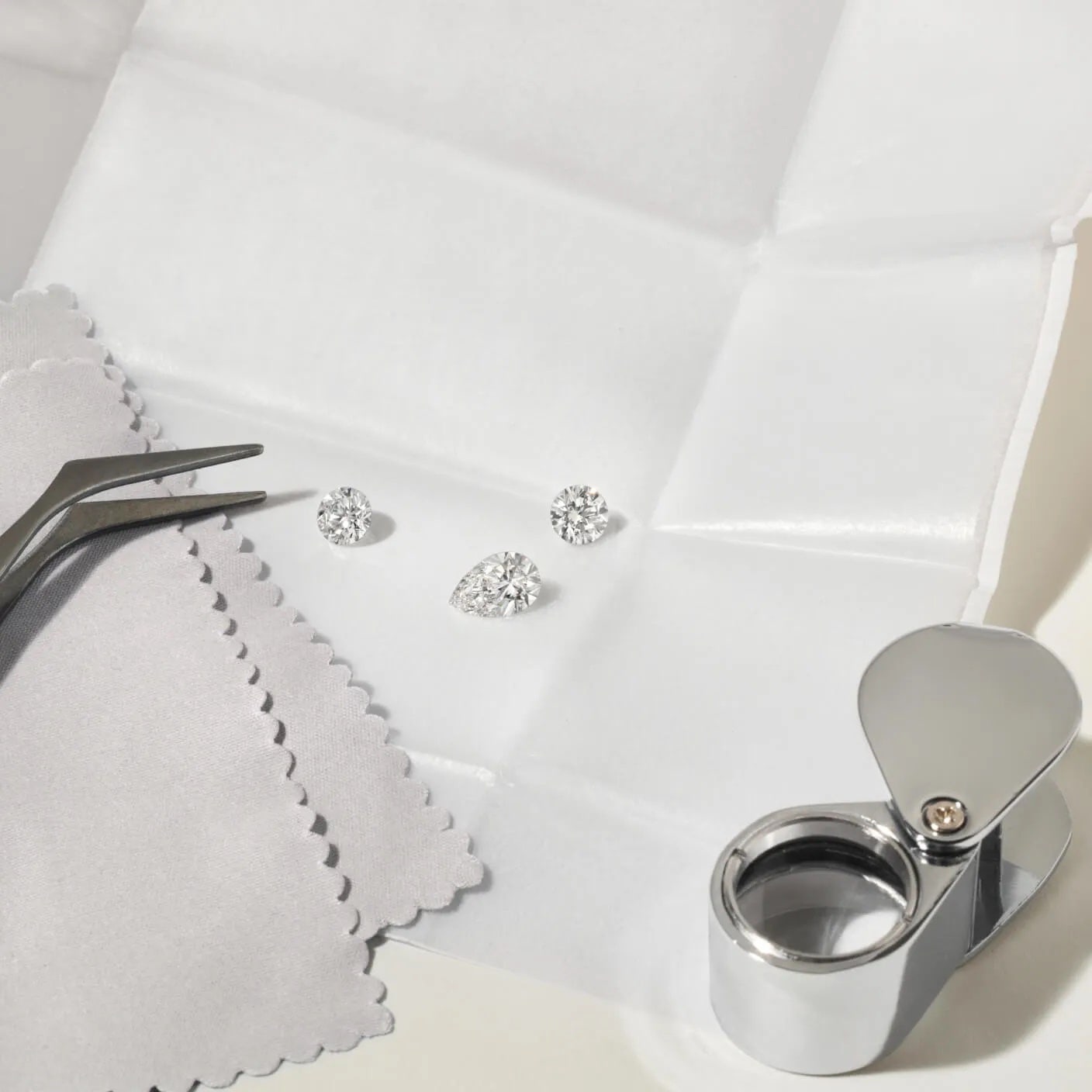
Lab diamonds are grown in a lab using cutting-edge technology that replicates the process of natural diamonds. A lab grown diamond is chemically, physically, and visually identical to a natural diamond.
Are Lab Grown Diamonds Real Diamonds?
When talking about lab grown diamonds, people question if they are "real diamonds." To which our answer is always the same — Yes! A lab grown diamond is real, just like a natural diamond. The only difference between diamonds grown in a lab and naturally mined diamonds is their origin.
Understandably, many people perceive lab grown diamonds to be "fake" diamonds, but the truth is that they are real diamonds. After all, lab grown does have a connotation with something synthetic. However, concerning lab created diamonds, this couldn't be farther from the truth! A lab grown diamond is not the same as a cubic zirconia or another diamond simulant.
The Science Behind Lab Grown Diamonds
To distinguish between lab grown diamonds and natural diamonds, we must first understand how natural diamonds are created. Do remember that both lab grown diamonds and their mined diamond counterparts are identical in every aspect except their origin.
Geologists believe that natural diamonds formed between 1-3 billion years ago deep within the Earth. Each of these diamonds starts as an element rich in carbon and is subject to immense pressure and high temperature. These conditions rearrange the carbon atoms in a particular crystal lattice structure, and over time a diamond is developed.
Eventually, these diamonds make their way close to the surface through a series of volcanic explosions. They rest for years until they are extracted harshly from the ground through large-scale mining operations.
How Are Lab Grown Diamonds Made? HPHT and CVD Processes
A lab created diamond will undergo one of two processes: High Pressure-High Temperature (HPHT) or Chemical Vapor Deposition (CVD).
HPHT Diamonds
In the High Pressure-High Temperature (HPHT) process lab grown diamonds use one of three distinct manufacturing processes: a belt press, the split-sphere (BARS) press, and the cubic press. While they may differ in their methodology, all these processes create an environment defined by extremely high pressure and high temperatures.
In essence, the process will expose a diamond seed covered in carbon to a temperature of roughly 1,500 degrees Celsius and a pressure of approximately 1.5 million pounds per square inch! This heat causes the carbon to melt around the seed, producing pure carbon diamonds with qualities identical to natural diamonds.
CVD Diamonds
In the Chemical Vapor Deposition (CVD) process, a lab grown diamond begins as a single diamond seed. However, unlike an HPHT diamond, it is placed within a controlled environment filled with a carbon-rich gas, such as methane. Exposed to a temperature of around 800 degrees Celsius, it causes the carbon particles in the gas to adhere to the diamond seed. The result is also a pure carbon diamond whose qualities are identical to a natural diamond.
How do HPHT and CVD Diamonds Differ?
Before we talk about how lab grown diamonds are made, it’s important to understand how natural diamonds are formed. The processes for natural and lab grown diamonds are extremely similar -- only one is a natural occurrence, while the other takes place in a lab.
HPHT Diamonds
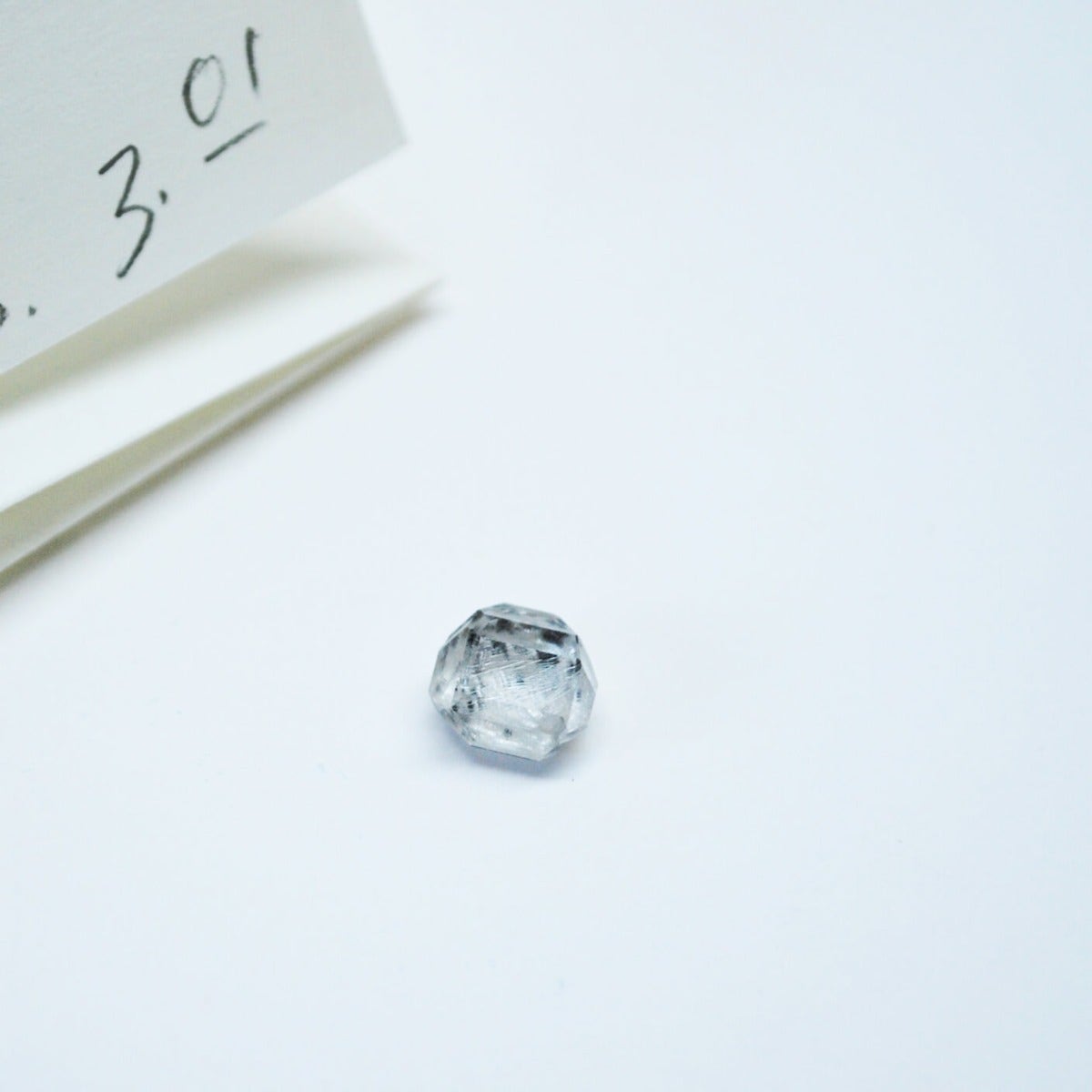
An HPHT diamond will grow as a cuboctahedron and in 14 different directions. They also tend to have a yellow hue due to the presence of nitrogen in their creation. Furthermore, they also have metallic inclusions, which makes them magnetic.
CVD Diamonds
A CVD diamond will grow as a cube and only in 1 direction. This process will produce a Type IIA diamond, a GIA designation for the most chemically pure diamonds. CVD diamonds will lack any traces of nitrogen or boron.
What Are Lab Grown Diamonds Made Of?
Whether a lab created diamond is grown through HPHT or CVD, the result will be the same: a lab grown diamond made of pure carbon. It is that simple because lab grown diamond and natural diamond are the same substance, which is pure carbon.
How Do Lab Diamonds Compare to Natural Diamonds?
A lab created diamond is optically, physically, and chemically identical to natural diamonds. The only difference is how they came into the world.
When you opt for lab created diamond over a natural diamond, you don't have to worry about sacrificing quality — they will both shine with the same sparkle!
How the Chemical Composition Affects Diamond Quality as Well as the Value
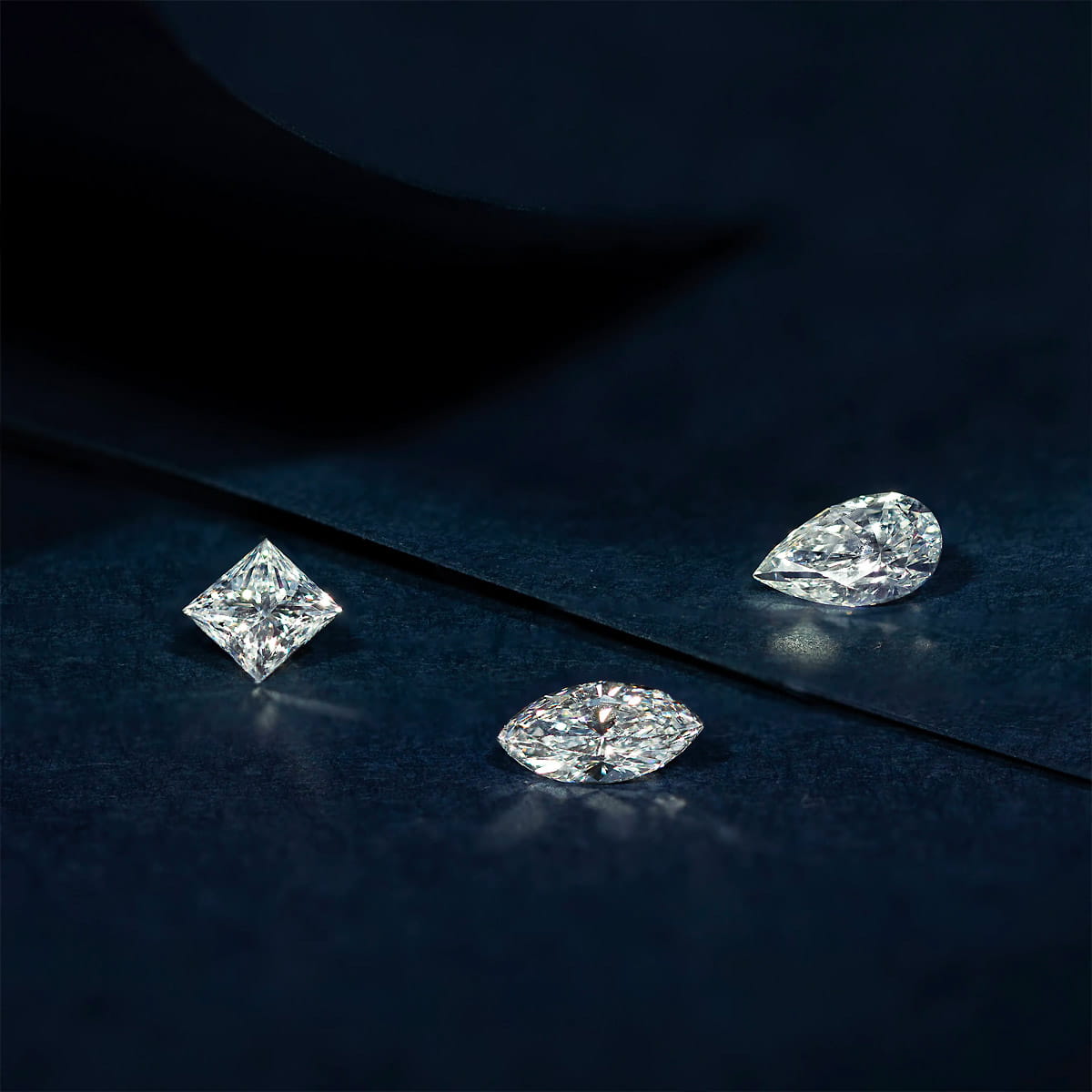
The chemical composition of lab grown diamonds directly impacts the 4Cs of diamonds, a grading system created by the Gemological Institute to define the quality of any particular diamond. These are:
Color - The color of a diamond is graded on an alphabetical scale that starts at D and ends at Z, with D being a colorless diamond and Z being yellow.
Clarity - The clarity grades of diamonds measure the prevalence of natural inclusions or imperfections found within a diamond.
Cut The cut of a diamond determines how effectively light that enters the stone is refracted within and reflected through the top of the diamond.
Carat Weight - The carat weight refers to the weight of a diamond. Each unit of measurement is equivalent to 0.2 grams (gm).
All of these factors combined affect the value of a diamond. The higher the quality of a diamond, the higher the price.
How Are Lab Created Diamonds Graded and Evaluated
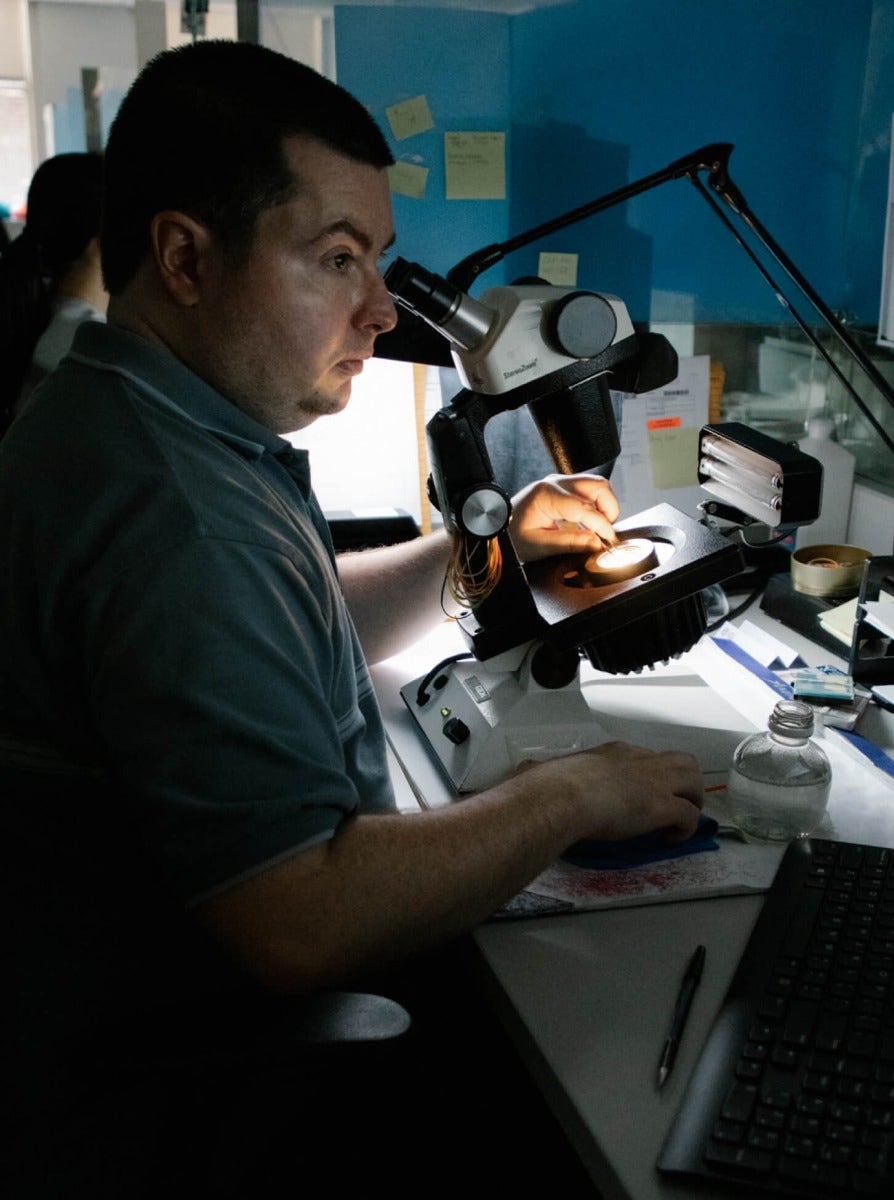
While the 4Cs of diamonds are the most common criteria for assessing diamonds, it is not standardized, so certification labs are free to use other systems to grade and evaluate diamonds.
The most popular diamond certification labs are The Gemological Institute of America (GIA), Antwerp World Diamond Center (AWDC), American Gem Society (AGS), International Gemological Institute (IGI), and Gemological Science International (GSI).
What Are the Physical Properties of Lab Created Diamonds?
A laboratory grown diamond has identical physical properties to a natural diamond. These are characteristics that can be observed and measured without altering the diamond. Some of the most common ones used when talking about lab created diamonds are:
Hardness, Toughness, and Durability
The hardness of a gemstone is defined by how well it resists scratches and other abrasions. The Mohs scale ranks gems on a relative scale based on their hardness, with diamonds ranked the highest — giving them the distinction of being the hardest gemstone.
Toughness measures a diamond's resistance to breaking and chipping, while durability refers to its sensitivity to chemicals and other environmental factors such as heat and humidity. Although diamonds are the hardest gemstone, they are susceptible to breaking when hit from certain directions and fracturing when subject to extreme temperature changes.
Optical Properties, Including Fire and Brilliance
A diamond's optical properties are the characteristics the naked eye perceives. These are its brightness, the white light reflected from a diamond, and its fire, flashes of color caused by the scattering of white light.
Thermal Conductivity and Electrical Conductivity
Thermal conductivity refers to how well heat transfers through a material; on that same note, electrical conductivity measures the ease with which electricity can pass through a material. Generally speaking, diamonds are not electrically conductive, but they are highly efficient as thermal conductors. This speaks more to their industrial uses than their inclusion in engagement rings.
What Are the Environmental and Ethical Considerations When Diamond Shopping?
The most important differentiation between lab grown diamonds and mined diamonds is their negative impact on the environment and human lives. Shopping for diamond jewelry does not have to weigh on your conscience. Diamonds are supposed to embody pureness and beauty, so it only makes sense that they are sourced responsibly and with consideration. Lab grown diamonds offer you peace of mind.
Ethical Concerns Regarding the Mined Diamonds Industry
Mined stones are lucrative for corporations in the diamond industry to dig up. Still, when they do so, it comes at a considerable cost: the well-being of the environment and communities. Traditional mining uses heavy machinery, explosives, hydraulic equipment, and other other harsh methods to extract diamonds found deep inside the Earth.
But before the digging even begins, tons of damage has already been done. These large mining operations cut down thousands of trees, contributing to the already alarming rate of deforestation — and causing further problems of global warming, soil erosion, loss of biodiversity, and desertification.
And that's not all. Acid mine drainage is yet another problem caused by leftover mining materials. When these react with oxygen in the air, it creates a chemical compound known as sulfuric acid that contaminates water sources. Not only does acid mine drainage hinder access to drinking water for humans and fauna, but it also affects food supplies since it damages the spoil and reduces crop yields.
How Can Lab Created Diamonds Help?
Lab diamonds are created using specialized equipment replicating the natural diamond growing process. A lab grown diamond offers the same clarity and quality as mined ones but is made in a manner that is less harmful to the environment.
Every lab grown diamond sold represents one fewer diamond extracted from the Earth. Your engagement ring means more than your undying love for each other. It also shows a passion for our planet when you choose lab grown diamonds.
According to a recent study from Frost & Sullivan , for every mined diamond carat. A lab grown diamond uses 250 million joules of energy, and while that sounds like a lot, it is 215.4% less than a mined diamond. Additionally, most of it is renewable energy, ensuring a cleaner process for creating a beautiful lab diamond.
Furthermore, lab grown diamonds emit only 6 pounds of carbon — a mere 4.8 percent of what mined diamonds produce — and absolutely no Sulphur oxide. In total, air emissions on a single carat of mined diamond are 1.5 billion times higher than those of a lab grown one.
How Lab Created Diamonds Are Changing the Jewelry Industry
Lab grown diamonds are not a trend that will disappear anytime soon, if ever. They are becoming more prominent in the jewelry industry and continue to be adopted by people all over the world.
Those who choose lab grown diamonds will notice that their prices are substantially lower than natural stone — anywhere from 20-40% less expensive. It's not because they are of lower quality but rather because of the reduced supply chain logistics.

Lab Grown Diamonds: What the Future Looks Like?
Lab diamonds have changed the diamond market forever. You can choose the more cost effective option with the same chemical properties as natural diamonds.
Please use this guide to make an informed decision based on how lab created diamonds compare to natural diamonds in terms of quality, creation, and origin.
At Clean Origin, we offer an extensive collection of fine jewelry for all special occasions and everyday wear. Are you looking for a lab grown or natural diamond engagement ring, a pair of stud earrings, tennis bracelets, or any other diamond jewelry? Clean Origin has it, and we want to help you find the perfect one!
Contact our customer service team through virtual consultations or at a showroom near you today. When you buy diamonds from Clean Origin, you can trust that you're receiving only the highest quality of lab created or natural diamonds.